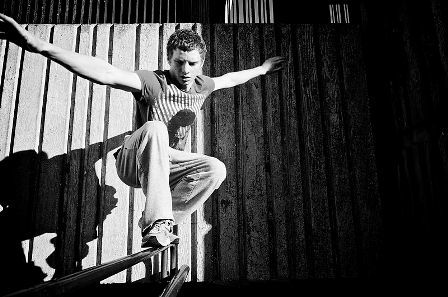
Parkour or free running has become increasing popular over the last few years especially since we first watched sebastie Foucan running, jumping and vaulting over the roof tops in the documentaries jump London and jump Britain. Now is is quite common to see participants or “traceurs” as they are known free running through the streets practicing the Monkey vault, kong vault, tic-tac and the other spectacular moves that parkour consists of.
The phylosphy of free running known as être et durer (“to be and to last”) is a wonderful concept and for me one of the most impressive aspects of parkour is the idea of relying on nothing more than your own body, skill and intelligence to get from point A to point B in the most artistic athletic and brave way possible and without the need for rules or spectators so that you become totally free.
The skills needed to master the advanced free running moves might take a number of years to develop and anyone who has previously practised gymnastics or martial arts will defiantly have a good platform to start from. However, for any traceur just starting out without this advantage there are still a number of bodyweight exercises that you can incorporate in your training program to ensure that you make quick progress in the tic-tac, wall run, precision jump and other moves that traceurs love.
The physical requirements needed for good free running
(1) A low bodyfat percentage The whole foundation of free running is based on the ability to pull and push your own bodyweight with ease which in turn requires a high strength to weight ratio. This can only be achieved if you carry as little fat as possible. So one of the first aims of all ambitious traceurs should be to follow a diet and exercise plan that allows a gradual reduction of fat until your fat percentage lowers to a maximum of 10% (The good news is that once you achieve this you will also have a great six pack).
(2) Explosive power The key to many free runing techniques is the ability to move your body with speed and strength at the same time. For example, the muscle up forms the foundation of free running wall techniques and the muscle up (a combined pull up and dip) requires not static strength but explosive power to execute successfully.
(3) Flexibility All traceurs should strive to develop a high level of flexibility throughout the body not just to assist in basic movements like the wallhop, catleap and tic-tac but also to help prevent injuries caused by positions outside the traceurs normal range on movement. In fact it is more or less impossible to become a proficient free runner without good flexibility.
(4) Stamina Although practising basic moves does not require a high level of stamina any traceur wanting to put together decent free run will certainly have to be very fit to complete it.
(5) C0-ordination and balance It goes without saying that any activity that involves jumping through and over obstacles with absolute precision needs the balance and co-ordination of a finely tuned athlete and plenty of courage to go with it.
The best bodyweight exercises for a parkour beginner
For explosive power and co-ordination new traceurs should focus on multi muscle or compound exercises (exercises that involve many muscles) because all free running movements including vaults such as the monkey vault, roll vault, reverse vault and all wall ups require complex multi muscle movements. The best compound exercises to begin with are jump squats, burbees, pull ups , press ups, dips, and v-sits. As soon as you are able to you should move on to more demanding compound exercises such as
For flexability I recommend that you begin each free running session with 10 minutes of dynamic stretching and finish each session with 20 minutes of passive stretching. For an in-depth guide on stretching have a look at the flexibility tutorial
For the stamina needed for long free running exploits traceurs should try interval running consisting of 5 x 100 metre sprints with each sprint followed by 100 metres of slow jogging before repeating the sequence. 0r put together a circuit of 10 basic bodyweight exercises and do 10 reps of each exercise before having 10 seconds rest and repeating the circuit 10 times.
Good luck
I leave you with some quotes by the Father of Parkour David Belle
“Everyone can do parkour. Parkour exists at the times where there is an obstacle in front of you and you are obliged to use your limbs to pass”
“When I have a problem, when I can’t progress, in life, belief or physical obstacles, those problems, there is always a way”
See how to build muscle for parkour
To help with your parkour see the splits guide